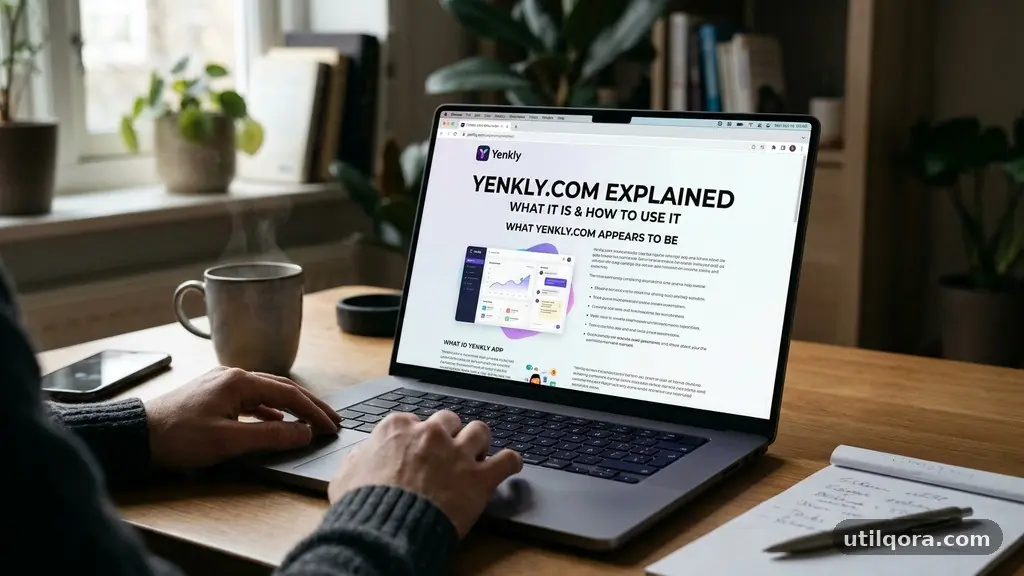
Yenkly.com Explained starts with an important distinction: a domain name alone doesn’t reveal what a service does, who operates it, or whether it’s suitable for sensitive information. Publicly available details about Yenkly.com are limited, so the safest way to approach the site is as an unverified online platform until its official purpose, ownership, policies, and support channels are clear. This article explains how to assess Yenkly, complete a Yenkly login or account registration carefully, recognise legitimate features, and respond to security or troubleshooting concerns without guessing at facts the site hasn’t confirmed.
What Yenkly.com Appears to Be
Yenkly.com is a web domain that may present itself as an online service, platform, portal, or account-based website. However, the name itself doesn’t establish whether it offers software, content, commerce, communication tools, financial services, or something else.
That uncertainty matters. A polished landing page can explain a service clearly, but a domain with minimal public information gives visitors little basis for deciding whether to create an account, upload documents, connect another account, or make a payment.
The most accurate answer to “what is Yenkly?” is therefore cautious: Yenkly.com should be treated as an identity that requires verification before use. Look for a clear description of the service, a named business or operator, an accessible privacy policy, terms of service, and a support method that works independently of the site’s login system.
Don’t assume that search results, social-media mentions, or a familiar-looking dashboard prove legitimacy. Those signals can help you find information, but they don’t replace checking the site’s own disclosures and the reputation of the organisation behind it.
A trustworthy service normally explains what data it collects, why it collects it, how long it keeps it, and how users can close their accounts. If Yenkly.com does not answer those questions in plain language, postpone registration rather than filling the gap with assumptions.
How to Verify the Website Before Signing Up
Before beginning the Yenkly sign-up process, inspect the website as though you were evaluating a new supplier. Start with the homepage, About page, contact page, privacy policy, and terms of service. The pages should identify the service’s purpose and provide consistent information about the operator.
Check whether the contact details are specific. A real business may list a support email, postal address, company name, or help centre, while a vague contact form with no organisational details gives you very little recourse if something goes wrong.
Look at the address bar carefully. The secure “https” connection protects data while it travels between your browser and the site, but HTTPS does not prove that a website is honest. Scam sites can also use valid security certificates.
Search for independent references, but interpret them carefully. A large number of copied reviews, newly created social profiles, or articles that repeat the same promotional wording may be less useful than a small number of detailed, verifiable user experiences.
For domain-related checks, an official resource such as the ICANN Lookup service can provide registration information when it is publicly available. Privacy protection may hide the individual registrant, so a lookup is a clue rather than a final verdict.
Pause immediately if the site pressures you to act quickly, requests cryptocurrency or gift-card payments, promises guaranteed returns, or asks for identity documents before explaining why they are needed. Those behaviours don’t automatically prove fraud, but they justify a much higher level of scrutiny.
Creating a Yenkly Account Safely
If the service passes your initial checks and you decide to proceed, use a separate password that has never appeared on another website. Password reuse creates a chain reaction: if an unrelated site suffers a breach, attackers may try the same email and password combination at Yenkly.
Use a password manager if possible. It can generate a long, unique password and save the correct login address, which reduces the risk of entering credentials into a lookalike phishing site.
During Yenkly account registration, provide only information that the service genuinely needs. An email address may be reasonable for account recovery, while a government identity number, bank login, or full financial profile requires a clear explanation and a stronger reason.
Read the consent screens instead of clicking through them automatically. Pay attention to optional marketing permissions, data sharing with partners, recurring charges, and clauses that allow the service to use uploaded content or contact you through several channels.
Keep a record of the registration date and the email address used. If you later need to dispute a charge, request deletion, or report suspicious activity, those details can help establish what happened.
- Use a unique password and avoid sharing it with support staff.
- Confirm the domain before entering an email address or password.
- Decline optional permissions unless you understand their purpose.
- Save receipts, confirmation emails, and subscription details.
- Stop if registration demands unexplained sensitive information.
Registration shouldn’t feel like an obstacle course. If a website makes basic account creation unusually confusing, hides costs, or refuses to explain its data requests, that experience is itself useful evidence.
What to Expect from the Yenkly Login and Dashboard
A Yenkly login page should show the same domain you intentionally visited, use a secure connection, and provide familiar recovery options without asking for another service’s password. Be suspicious of pages that imitate a bank, email provider, social network, or payment processor while claiming to be part of Yenkly.
After signing in, inspect the Yenkly dashboard before using any major feature. A credible dashboard usually makes the account owner, current plan, recent activity, notifications, settings, and support route easy to identify.
The Yenkly user interface should also make important actions understandable. You should be able to tell whether a button submits information, starts a subscription, sends a message, publishes content, or permanently deletes data.
Don’t judge the platform solely by visual polish. Clear labels, predictable navigation, accessible account controls, and visible billing information are more valuable than animated graphics or a modern colour scheme.
If the dashboard contains unfamiliar activity, review the account immediately. Change the password from a trusted device, sign out other sessions if that option exists, and contact support through a verified address rather than replying to a suspicious message.
Take screenshots of important screens before making changes. This is particularly helpful if the platform displays a balance, order, subscription, ticket, or account status that later changes.
| Area to inspect | Healthy sign | Warning sign |
|---|---|---|
| Login | Correct domain, secure connection, sensible recovery process | Unexpected redirects or requests for another service’s password |
| Dashboard | Clear account status, settings, activity, and help options | Unexplained charges, urgent alerts, or hidden controls |
| Billing | Visible prices, renewal dates, and cancellation instructions | Recurring fees revealed only after payment |
| Privacy | Readable explanation of collection, use, retention, and deletion | Broad data permissions with no practical explanation |
Yenkly Features and Services: How to Judge Them
It isn’t responsible to list specific Yenkly features as confirmed facts without reliable documentation from the operator. A service may advertise a dashboard, messaging, file storage, marketplace tools, automation, or another capability, but marketing language isn’t the same as an independently verified product description.
Instead, assess each feature by asking four practical questions: What does it do, what information does it require, what does it cost, and how can you reverse or cancel the action? Those questions turn vague promises into concrete decisions.
For example, if Yenkly offers file uploads, find out whether files are encrypted, who can access them, the maximum retention period, and whether deletion removes backups as well. If it provides messaging, check whether messages can be exported, deleted, or reported.
Payment-related Yenkly services deserve additional care. Confirm the currency, one-time or recurring nature of the charge, refund rules, renewal date, and name that will appear on your card statement before authorising payment.
Be cautious with claims that use words such as “instant,” “guaranteed,” or “risk-free.” A legitimate feature can still have limits, eligibility requirements, delays, or costs, and those details should appear in the service documentation.
Record the version of the terms or pricing page you accepted. Websites can change policies, and a saved copy or screenshot gives you a clearer reference if a later dispute concerns what was disclosed at registration.
Privacy, Data Use, and Account Security
The Yenkly privacy policy should explain the categories of personal information collected and the reason for each category. Look for details about contact information, device data, cookies, payment records, uploaded material, analytics, and information shared with vendors.
A useful policy also states how users can exercise their rights. Depending on the service and your location, that may include requesting access, correcting inaccurate information, deleting an account, withdrawing consent, or objecting to certain processing.
Account security begins with your own login habits, but it doesn’t end there. Enable multi-factor authentication if Yenkly provides it, review active sessions, avoid public computers for sensitive work, and keep your browser and operating system updated.
Never send a password, one-time authentication code, or recovery phrase to Yenkly customer support. Genuine support agents may verify account details, but they should not need credentials that give them direct access.
Watch for phishing messages that use Yenkly branding. A message may include the correct logo and a convincing sign-off while directing you to a different domain, a shortened link, or a form that captures your password.
If you suspect compromise, act in this order: stop using the affected session, change the password from a clean device, revoke unknown sessions, secure the email account connected to Yenkly, and review payment activity. Contact the service only through contact information found independently on its official site.
Yenkly Account Management and Payments
Account management should include basic controls such as changing an email address, updating a password, reviewing notifications, downloading personal information, and closing the account. If those options are missing, find out whether support can perform them and how the request is authenticated.
Before paying for a Yenkly plan or service, capture the checkout page. Save the price, taxes, billing interval, trial conditions, cancellation deadline, and refund terms, since these details may not be displayed in the same place later.
Free trials deserve special attention. A trial can convert into a paid subscription automatically, sometimes after a short period, so check the renewal date and set a calendar reminder before starting it.
Use a payment method that gives you a clear transaction record. Avoid sending money directly to an individual or using irreversible methods when the business identity, refund policy, or service delivery remains unclear.
If a charge appears that you don’t recognise, compare it with confirmation emails and the account’s billing history. Contact the merchant promptly, and if the response is inadequate, ask your payment provider about its dispute process.
Closing an account may not delete every record immediately. The privacy policy should explain legal retention, fraud prevention, backups, and the treatment of information that has already been shared with service providers.
Yenkly Troubleshooting and Customer Support
Technical problems can come from the website, your browser, a network filter, an expired session, or an incorrect password. Start with low-risk checks: confirm the URL, refresh the page, try a current browser, disable conflicting extensions temporarily, and test a different network.
Don’t repeatedly submit a login form if it may be failing silently. Multiple attempts can trigger a temporary lockout, and repeated password resets can create confusion about which reset link remains valid.
For a failed transaction, check whether your bank declined it, whether the amount was reserved rather than charged, and whether the platform sent a receipt. Avoid making several payments while the first transaction is still pending.
Good Yenkly customer support should explain expected response times, provide a ticket number, and avoid requesting unnecessary sensitive data. Keep the conversation in writing when the issue concerns billing, account access, privacy, or a security incident.
When reporting a problem, include the time of the error, device and browser, exact wording of the message, and steps that produced it. Never include your password, complete card number, authentication code, or identity document unless the need is clearly explained through a verified channel.
If support stops responding, the website disappears, or staff pressure you to pay additional fees to release funds or restore access, stop sending money. Preserve records and consider contacting your bank, relevant consumer-protection authority, or local law-enforcement agency.
Who Should Use Yenkly?
Yenkly may be suitable for someone who can verify the operator, understand the service’s purpose, and use it without surrendering information that exceeds the service’s needs. A user should also be comfortable checking policies, monitoring activity, and stopping if the platform behaves unexpectedly.
It may not be appropriate for children, people managing another person’s financial affairs, or anyone who cannot independently assess payment and privacy terms. Extra safeguards are needed when an account involves health records, identity documents, employment information, or substantial funds.
Businesses should conduct a separate review before allowing employees to use Yenkly. That review might include vendor ownership, data-processing terms, administrator controls, export capabilities, breach-notification commitments, and account recovery procedures.
Parents and carers should avoid assuming that a service is safe simply because its interface looks simple. Check whether direct messages, public profiles, location data, advertising, or contact discovery are enabled.
For casual browsing, the risk may be limited if you don’t register, download files, or submit personal information. For any activity that creates an account or involves payment, the verification standard should be much higher.
The right decision isn’t always “use it” or “never use it.” A sensible approach is to begin with the least sensitive activity, test support, review the controls, and expand usage only when the service earns confidence through clear behaviour.
Practical Steps for Safer Use
Use Yenkly in stages rather than committing immediately. First inspect the public pages, then create an account with minimal information, then test ordinary functions before uploading important files or paying for a plan.
Keep Yenkly separate from critical accounts. Don’t use the same password as your email, banking, work systems, or primary social-media account, and don’t connect those accounts unless the benefit is clear and the permission screen is specific.
Review the account once a month if you continue using the service. Check recent logins, connected applications, payment activity, marketing settings, and any changes to the privacy policy or terms of service.
Maintain an exit plan. Know how to export useful information, cancel a subscription, remove a payment method, request deletion, and reach support if the normal login stops working.
These habits are practical because they reduce the impact of uncertainty. You don’t need to predict every possible problem; you need to limit the amount of access, money, and personal data exposed before the service has demonstrated that it deserves trust.
Frequently Asked Questions
Is Yenkly.com a legitimate website?
The domain name alone cannot establish legitimacy, and publicly available information may not be enough to verify the operator or purpose. Check the site’s identity, privacy policy, terms of service, contact information, independent reputation, and payment disclosures before registering or sending sensitive information.
How do I complete a Yenkly login safely?
Type the address yourself or use a trusted bookmark, confirm the domain and HTTPS connection, and use a unique password. Avoid login links from unexpected emails, never share one-time codes, and review active sessions after signing in.
What should I do if the Yenkly dashboard shows unfamiliar activity?
Take screenshots, stop using the suspicious session, and change your password from a trusted device. Revoke unknown sessions, secure the email account linked to Yenkly, check payment records, and contact support through an independently verified official channel.
Does Yenkly offer customer support?
Don’t assume support quality or availability until the official site states how it works. Look for a named help centre, support email, ticket system, response expectations, and a process that doesn’t require you to disclose passwords or authentication codes.
Can I trust Yenkly with identity or financial information?
Only consider it after verifying why the information is required, how it will be protected, who may receive it, and how long it will be retained. If the privacy policy is missing, vague, or inconsistent with the registration form, don’t submit those details.
Final Takeaway
Yenkly.com Explained is ultimately a lesson in verification rather than a reason to assume what an unfamiliar platform offers. Treat the domain cautiously, inspect its policies, use a unique password, test the dashboard with low-risk information, and document payments or account changes.
If Yenkly clearly identifies its operator and explains its features, services, privacy practices, and support process, you can make a more informed decision. If those basics remain unclear, protecting your data and money means waiting, asking questions, and choosing a better-documented service.